
You don’t need a fancy art studio, a set of 150 colored pencils, or a weekend retreat in the mountains to start drawing. You need a pencil, a piece of paper, and about ten minutes. That’s it. Drawing the easy way isn’t about waiting until you feel “ready.” It’s about picking up whatever you have right now and making marks on a page.
It’s Easy To Draw is an online art academy and website built for adult beginners and intermediates who want practical, no-nonsense drawing tutorials and drawing lessons they can actually use. The whole philosophy is simple: short daily practice, basic objects, minimal supplies, and a clear step drawing process that builds real drawing skills over time. No gatekeeping. No perfectionism. Just pencil on paper, every single day.
And here’s the part that surprises most people: human faces don’t need to be daunting. You don’t have to wait years to start drawing human faces. You can start immediately once you understand the concepts of sketching, shaping, and shading in detail, what I call the drawing pyramid. These are all parts of The Fundamentals of Drawing course over at It’s Easy To Draw Academy. And for faces specifically, The Easy Way to Draw Faces walks you through every step.
In this article, we’ll cover how to build a daily drawing habit, how to draw simple objects using shapes and light, how to start faces way earlier than you think, and why being part of a creative community makes all the difference.

Start with Daily Micro‑Sessions: Building the Habit First
Here’s the truth that nobody tells you: a ten-minute drawing session every day will improve your art faster than a four-hour marathon on a random Sunday. Engaging in short daily practice sessions can enhance drawing skills over time because your brain needs repetition, not exhaustion. Drawing skills can be built through consistent practice and exercises, not through bursts of inspiration followed by weeks of nothing.
A Simple Drawing Lessons Routine That Works
Try this: every morning from 7:15 to 7:30 a.m., before work, before emails, before the world gets loud – you draw. Monday through Friday. Fifteen minutes. That’s your creative window.
Your tiny goals for each session might look like this:
Day | Exercise | Time |
|---|---|---|
Monday | Draw one coffee mug | 15 min |
Tuesday | Sketch five quick gesture lines of a hand | 15 min |
Wednesday | Fill a page with shaded spheres | 15 min |
Thursday | Draw an apple from observation | 15 min |
Friday | Practice one facial feature (eyes, nose, or mouth) | 15 min |
You can also rotate in simple beginner subjects like leaves, shoes, or animals.
Daily warm-up exercises can prepare your hand for drawing, just like stretching before a run. Even a minute of loose circles and straight lines warms up your wrist and gets you into the zone.
The Step Drawing Method: Drawing Tutorials for Beginners
For every subject, follow a simple 3-to-5 step process:
- Block in basic shapes – circles, rectangles, ovals
- Refine the outline – adjust proportions, clean up edges
- Add light direction – decide where the light hits
- Shade for volume – build up darks and midtones
- Add details – small textures, finishing touches
Use a timer. Use a cheap sketchbook or even printer paper. A single HB pencil is enough. Withdrawing from perfectionism helps ease the pressure when practicing drawing – your sketchbook isn’t a gallery wall, it’s a gym. It’s Easy To Draw courses are structured around short, focused drawing lessons that plug right into this kind of daily schedule.
Drawing Basic Objects the Easy Way: Shapes, Light, and Shadow
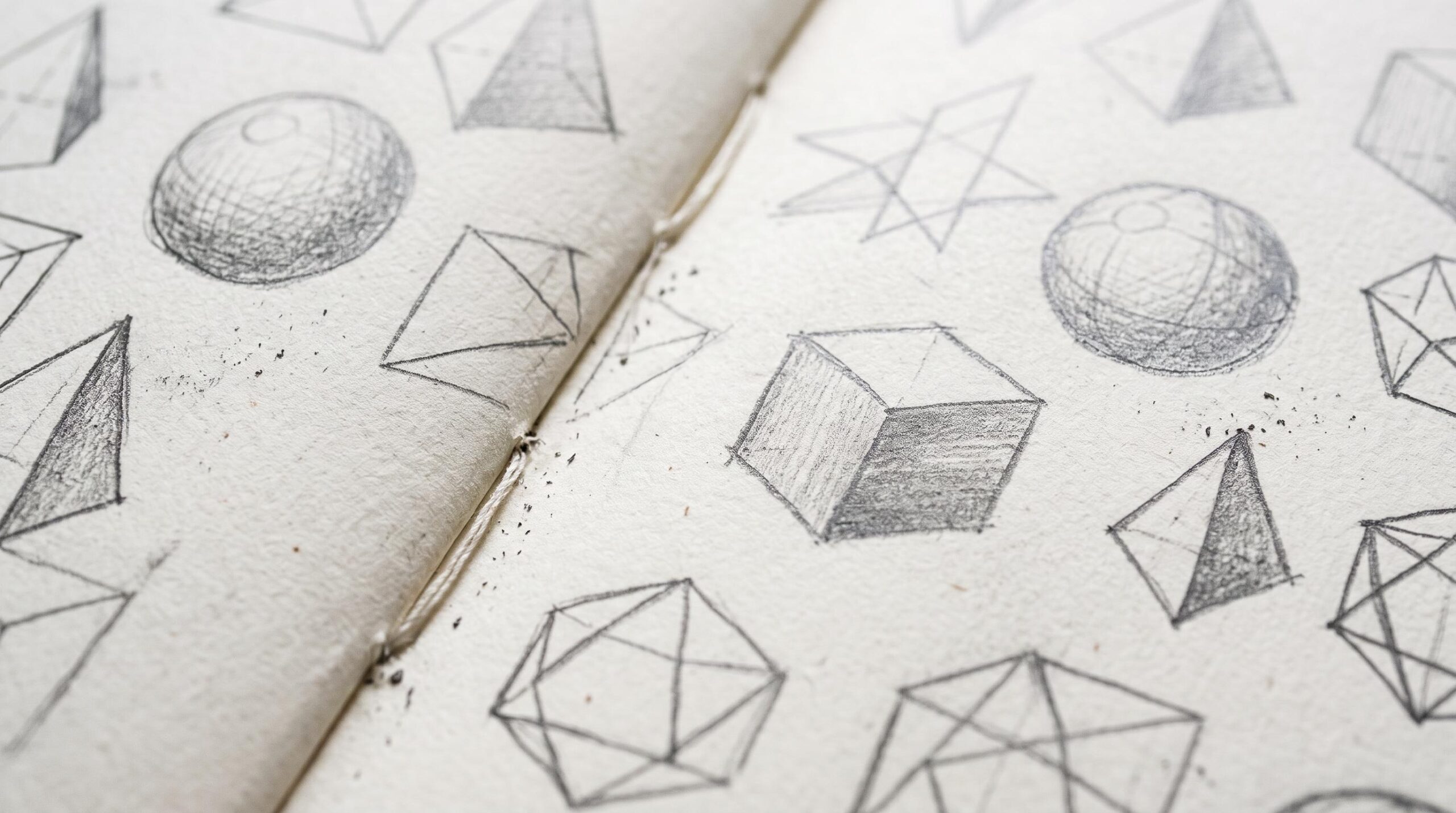
Everything you see can be broken down. A coffee mug is a cylinder. A book is a box. An orange is a sphere. A table lamp is a cone sitting on top of a cylinder, and the same approach works for flowers, too. Basic shapes can simplify complex objects into manageable forms, and once you learn to see the world this way, drawing stops feeling impossible and starts feeling like a puzzle you already know how to solve.
Practicing simple shapes can help beginners develop confidence before moving to more complex subjects. That confidence is everything.

How to Approach Each Object
Pick any everyday item. Here’s the process:
- Lightly sketch the underlying shape lightly. Using light pressure helps in easily adjusting proportions while drawing, so you can erase and shift things around without fighting the paper.
- Refine the silhouette. Sketching over established shapes can enhance the drawing process for beginners. You’re not starting from scratch, you’re sculpting what’s already there.
- Identify the light source. Where is the light coming from? Mark the highlight, the midtone areas, and the shadow side.
- Shade for depth. Using shadows and highlights adds depth and realism to drawings. Even a simple sphere with a gradient from light to dark suddenly looks three-dimensional.
Try drawing from the shoulder rather than the wrist. Drawing from the shoulder helps create longer, smoother lines, especially for larger shapes and sweeping curves.
Practice Light and Shadow Separately
Here’s a tip most simple drawing tutorials skip: don’t always try to finish a “real” drawing. Spend entire sessions just on value practice. Fill a page with shaded spheres and cubes. Practice gradients. Use a five-value system: highlight, light, midtone, core shadow, and cast shadow. Proko’s lessons on value scales demonstrate how limiting yourself to just five values simplifies the entire shading process.
Varying line weight can add depth to a drawing even before you shade. Thicker lines on shadow edges, thinner lines where light hits. And try drawing the negative space around objects to see shapes distinctly for better accuracy. Drawing the negative space helps you see what’s actually there instead of what your brain assumes is there.
Spend a dedicated week. Say, November 1 through 7 – focusing only on forms and values. No finished pieces. Just drills. The Fundamentals of Drawing teaches this pyramid approach: sketching, shaping, then shading, in exactly that order. If you need ideas for what to draw during your practice week, browse 100+ drawing ideas for inspiration that matches any skill level.
Understanding light and shadow with a pencil also directly prepares you for working with color later. When you eventually move to colored pencil techniques, you’ll find that clear values make your coloring pages and colored artwork look dramatically more realistic. If your values are off, no amount of beautiful color will save the piece.
Human Faces Made Simple: From Basic Forms to Confident Portraits
Let me say it again: you don’t need years of practice before attempting faces. If you can draw a circle and a straight line, you can start faces today. The moment you grasp shapes and simple shading (the same skills you’ve been building with mugs and oranges) you’re ready.
See the Head as a Shape, Not a Mystery
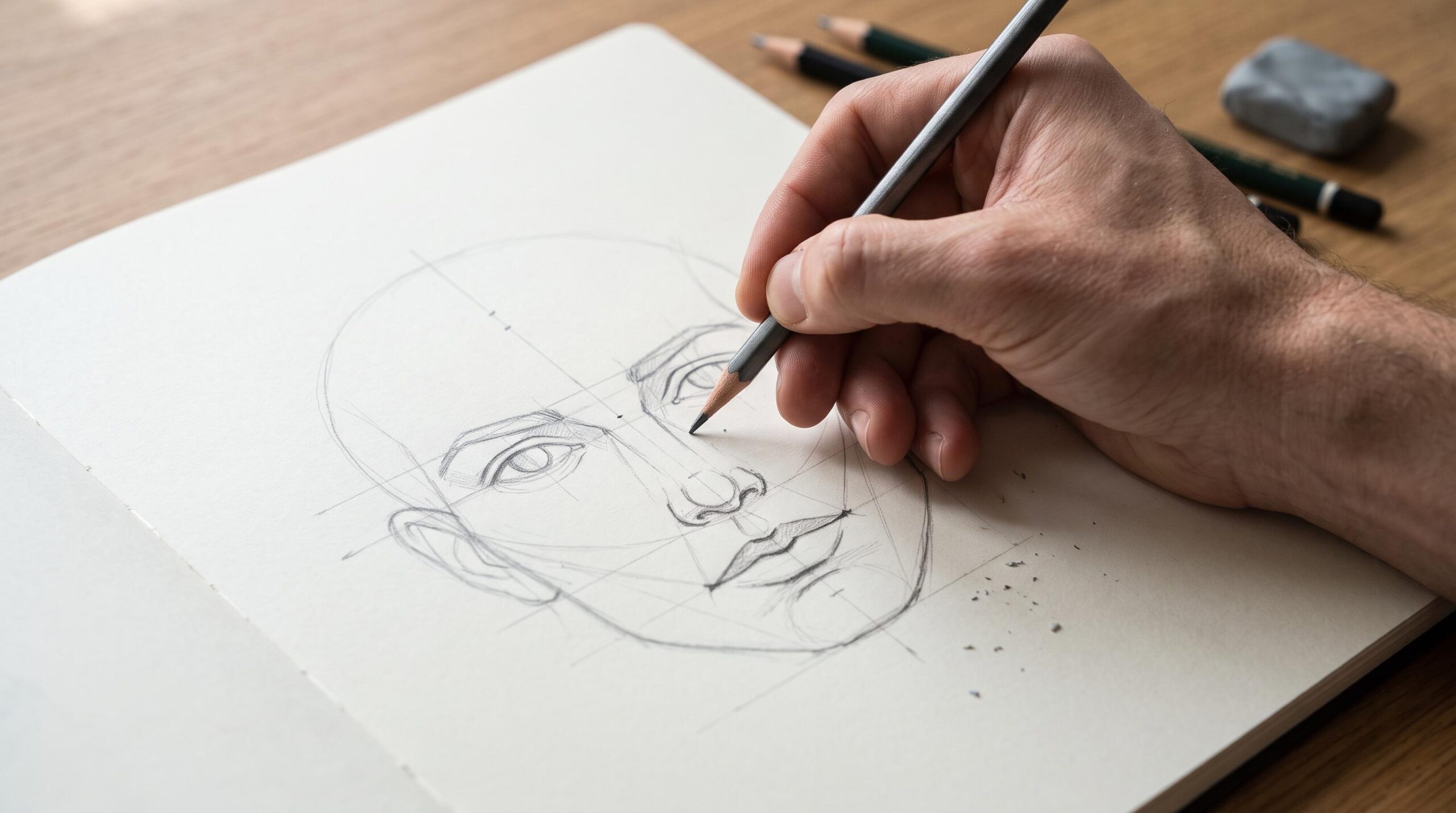
The human head is essentially an oval (or an upside-down egg shape). The neck is a cylinder. That’s it. From there:
- Draw a vertical center line down the middle of the oval
- Draw a horizontal line halfway down for your eye line
- The bottom of the nose sits halfway between the eye line and the chin
- The mouth sits roughly one-third of the way between the nose and the chin
- Ears align between the eye line and the bottom of the nose
These aren’t guesses. These are construction guidelines, and they transform face drawing from terrifying to methodical. Using reference images can improve the accuracy of drawings, so keep a photo nearby as you practice and compare your proportions.
A Daily Face Practice Routine
Here’s what works:
- Daily: Draw 5–10 simplified head outlines. Just ovals with center lines and feature placement marks. No detail, no likeness attempt. Just shape and proportion.
- Feature days: Dedicate sessions to a single feature. A whole page of eyes. A whole page of noses. A page of mouths. This builds your visual vocabulary without the stress of nailing a full portrait.
- Weekly: Pick one face and do a full value rendering: light, shadow, midtone, the whole thing.
Blind contor drawing encourages observational skills by focusing on the subject rather than the paper. Try drawing a face without looking at your hand. It feels weird, but it trains your eye to actually see edges and curves instead of relying on memorized symbols.
The Easy Way to Draw Faces course walks students through this entire process using clear drawing tutorials rather than dense anatomy charts. It’s built for beginners who want to draw faces now, not after a semester of figure drawing. The focus stays on minimal tools (pencil, eraser, sketchbook) and later connects to realistic drawings using colored pencils for those who want more depth.
Students can also explore foundation in drawing guides for additional practice, and print free coloring pages of faces or grayscale portraits from It’s Easy To Draw resources to practice shading over ready-made line art. Cute drawings of simplified faces make excellent warm-up exercises too.
Community, Accountability, and Free Resources to Keep You Going
Here’s the part most art tutorials don’t talk about enough: staying consistent alone is brutally hard. You miss a day, then two, then a week, and suddenly your sketchbook is collecting dust. Without being part of a tribe, it is very difficult to stay on point. Social art communities provide valuable feedback and motivation for artists, and that feedback loop is often the difference between someone who draws for a month and someone who draws for life.
The It’s Easy To Draw Artisan Program
The It’s Easy To Draw Artisan program and membership bring everything together: an online community space, feedback from peers, structured drawing lessons, and a shared sense of purpose. You can explore the full academy to see what’s available.
Here’s how accountability actually works in practice:
- Post a daily sketch in the community. Even a rough 10-minute study counts. The act of sharing creates a commitment you don’t want to break.
- Watch others grow alongside you. Seeing fellow beginners post their progress is one of the most motivating things in art. You learn from their work and they learn from yours.
- Get real feedback – not just “nice job” but useful observations about your proportions, values, and line quality. You can follow along with others working on the same lessons.
Free Resources and Free Coloring Pages to Start Right Now
You don’t have to spend a cent to begin. Easy Drawing Guides offers over 1,900 free coloring pages, and DrawingNow provides printable coloring pages for kids and beginners. Coloring pages can be downloaded or colored online, making them accessible from anywhere. Printable coloring pages are suitable for various skill levels, from absolute beginners to more experienced artists looking for relaxed practice.
Beyond coloring pages, Easy Drawing Guides offers over 1,900 drawing tutorials with step-by-step instructions and how-to videos. DrawingNow provides thousands of free step-by-step drawing lessons as well. Kids aged 6-15 can find dedicated drawing lessons on these platforms, and easy drawing tutorials cater to beginners and children – but honestly, adults benefit from these step by step guide resources just as much. There’s no age limit on learning to draw. It’s suitable for all ages.
Research in cognitive psychology confirms that repeated drawing practice improves visual recognition and discrimination, meaning your observation skills genuinely sharpen the more you sketch. The benefits are real and measurable.
At It’s Easy To Draw, members also get access to drawing tutorials, worksheets, and free coloring pages, with new resources added over time to support daily practice. Start with whatever free resources grab your attention, explore what’s available on the learning center, and then move into The Fundamentals of Drawing when you’re ready for deeper study.
Your 30-Day Challenge Starts Now
Here’s my invitation to you: commit to 30 days of short daily drawing. Ten to fifteen minutes. One pencil. One sketchbook. That’s the whole setup. Sign up for the community so you have people to share your progress with. Use the courses as your roadmap. Check in daily, even on the days your sketch looks terrible.
Habit formation research suggests it takes anywhere from 21 to 66 days to build a consistent habit, depending on the activity. A month of daily drawing covers that sweet spot. You’ll improve your skills, build your confidence, and most importantly you’ll start to love the process.
Drawing is fun when you stop treating it like a test and start treating it like play. Grab a pencil. Read the first lesson. Create something today, even if it’s just a wobbly circle.
It really is that easy.