
What to Draw
Out of ideas? 100+ drawing prompts and project ideas for beginners, intermediate artists, and everyone in between.

Running out of drawing ideas is not a creative flaw. It is a natural part of the artistic journey that every artist experiences, regardless of skill level. Studies have shown that people routinely underestimate their own creative capacity, believing they have exhausted their ideas when in fact they have plenty more to discover. The block you feel is often just a signal to approach the page differently.
This list is organized by mood and skill level so you can find exactly what you need right now. Looking for something simple to warm up with? Start with the beginner section. Feeling uninspired and need a creative spark? Jump to the drawing prompts. Want a weekend challenge? Explore the subject-specific categories or the colored pencil section at the end.
Here is how to use this resource: skim the categories, pick one item that resonates with where you are today, set a 20-minute timer, and start drawing. Do not overthink the selection. Fun and inspiring drawing subjects allow artists to develop skills while enjoying the creative process. The items are numbered 1 through 100 continuously, so you can easily track what you have tried and return to explore more ideas later.
Easy Things to Draw When You’re Starting Out
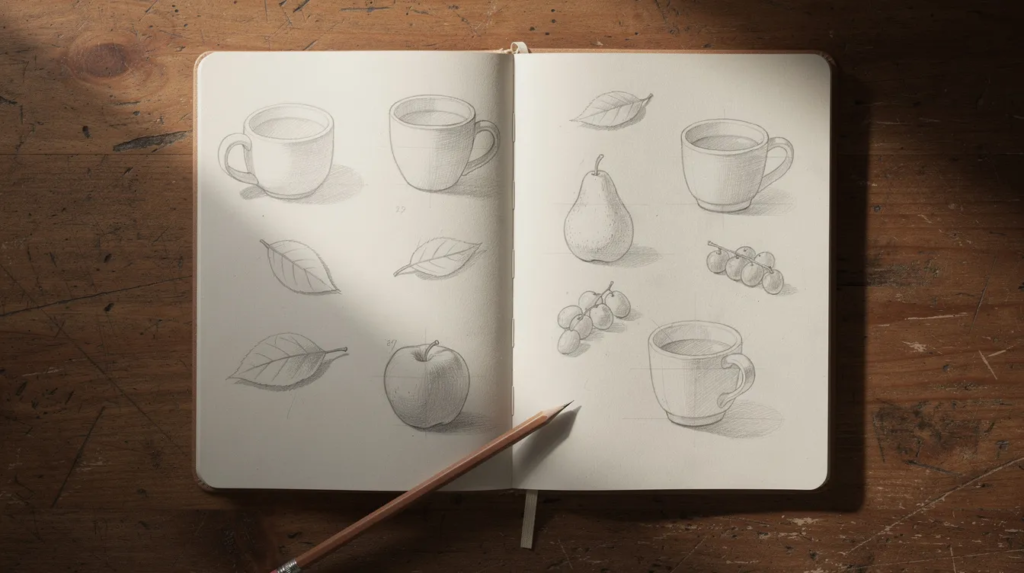
Drawing simple subjects like animals, plants, and everyday objects can be a great way for beginners to practice their skills. This section is for those just picking up the pencil or returning after years away from the page. Each subject here emphasizes fundamental forms, basic shapes, and confidence-building repetition. If you want a deeper foundation in technique, explore the Getting Started with Drawing guide for step-by-step instruction.
Starting with basic shapes is essential for drawing any object, as it helps in visualizing the 3D form in a 2D space. Beginners can start with basic shapes in nature or daily items, while experienced artists can focus on challenging textures, lighting, and anatomy. Prioritize sketching daily and embrace making mistakes to build confidence.
- A single sphere. The sphere teaches you everything about light, shadow, and form in one simple shape. Focus on identifying the light source and creating a smooth gradient from highlight to core shadow.
- A wooden cube. Cubes introduce perspective and edge control. Draw it slightly below eye level so you can see the top plane, and pay close attention to how each face catches light differently.
- A cylinder from observation. Find a can or drinking glass and sketch it from life. Cylinders combine the curved shading of spheres with the straight edges of cubes.
- Your morning mug. The handle adds complexity to the cylinder form. Notice how the handle creates negative space and casts its own shadow onto the body of the cup.
- A single egg. Eggs are forgiving because slight asymmetry looks natural. Use this subject to practice soft transitions between values.
- A basic leaf shape. Plants and leaves are forgiving and easy to sketch, ranging from ferns to succulents. Start with the central vein, then build the outline around it.
- An apple or pear. Fruits and vegetables are ideal still life subjects because they possess simple, organic forms. The stem creates a nice focal point for practice.
- A folded cloth napkin. This introduces you to fabric folds without overwhelming complexity. Look for the primary fold lines and simplify.
- A door knob. The reflective surface forces you to observe carefully. Sketch the basic shapes first before adding any details.
- Your keys on a table. Keys combine geometric and organic shapes. Drawing them overlapping teaches you about spatial relationships.
- A sealed envelope. The flat planes and crisp edges make this an ideal subject for understanding value changes on flat surfaces.
- A single spoon. The reflective curve challenges you to see abstract shapes of light rather than drawing what you think a spoon looks like.
- A simple boot or shoe. Footwear teaches proportion and form without the complexity of human anatomy. Draw it from the side first.
- An old book, closed. The stacked pages create subtle value variations. Notice how the spine catches light differently than the cover.
- A smooth stone. Doodling shapes and patterns is an excellent way to practice hand-eye coordination, and stones offer infinite variety in simple forms.
Cute Things to Draw
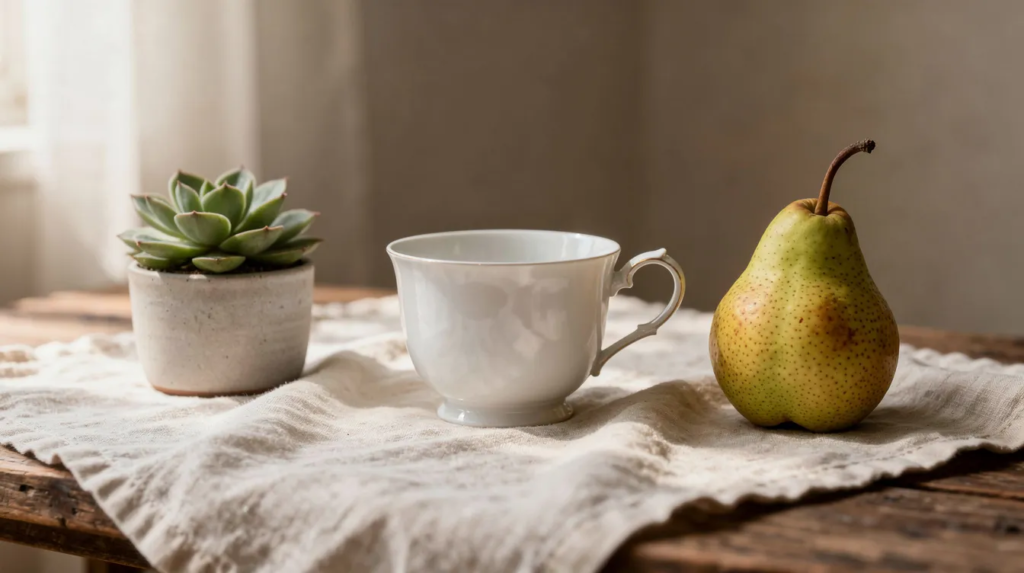
This section features subjects with refined charm rather than childish appeal. Think botanical elegance, artfully arranged food, small animals in natural poses, and everyday objects with inherent warmth. These things to draw work well for artists who want approachable subjects without sacrificing sophistication.
Some easy drawing ideas include a hamster, moon and star, bear, and a cute dinosaur, which are all beginner-friendly subjects. Here you will find similar approachable subjects treated with an adult aesthetic sensibility.
- A sprig of eucalyptus. The silvery leaves have a natural elegance. Study the way the leaves attach to the stem and vary in angle.
- A French macaron pair. The ruffled edges and smooth domed tops create interesting texture contrasts. Use light pressure to capture the delicate surface.
- A sleeping kitten. The curled posture simplifies the form while maintaining warmth. Focus on the overall gesture before adding fur texture.
- A teacup with saucer. The classic still life subject rewards careful observation. Notice how the rim creates an ellipse that changes based on your viewing angle.
- A potted succulent. The geometric leaf patterns and compact form make this an ideal subject. Each leaf is a simple shape repeated with variation.
- A croissant on a plate. The layered, flaky texture challenges you to suggest detail without overworking. Leave some areas loose.
- A small bird on a branch. Simplify the body into an egg shape, then add the head as a smaller circle. The feet are the finishing detail.
- A jar of honey with dipper. The amber transparency and wooden texture create lovely contrast. Observe how light passes through the glass.
- Fresh lavender bundle. The repetitive small flowers teach patience and rhythm. Work from the stem outward.
- A breakfast scene from above. Arrange toast, a cup, and a small plate for an overhead composition study. This view flattens forms into simpler shapes.
- An old-fashioned pocket watch. The mechanical details reward close observation. Start with the basic circles before adding any interior elements.
- A small hedgehog. The spiny texture can be suggested with directional marks rather than drawn spine by spine.
- A wine glass with water. Study how the water level creates a visible line and how the stem reflects on the surface below.
- A stack of macarons. Building on the single macaron, this teaches you about repeated forms and subtle shadow relationships.
- A small potted herb. Basil or mint in a terracotta pot combines organic growth with geometric container. Notice how leaves overlap.
Cool and Aesthetic Things to Draw
This category emphasizes visual impact through strong composition, dramatic lighting, and graphic clarity. These cool things to draw suit artists ready to explore silhouettes, single-color studies, bold line work, and geometric patterns. The focus here is on developing your artistic eye and making sophisticated visual choices.
- City skyline at dusk as a pure silhouette. Eliminate all interior detail and focus only on the outline against a gradient sky. This teaches shape language.
- Full moon over a forest treeline. The strong circular form against irregular organic shapes creates natural contrast. Keep the moon simple.
- Architectural window with dramatic shadows. Focus on scenes with strong, high-contrast lighting, such as an old building at sunset. The geometric patterns of light and dark simplify naturally.
- Moroccan tile pattern study. Geometric repetition builds hand control and teaches you about positive and negative space relationships.
- A single leaf with strong side lighting. The edge-lit quality creates a graphic silhouette effect while still showing some interior detail.
- Your hand in dramatic shadow. Position a single light source to cast bold shadows. Draw only what you see, not what you know.
- Glass bottle with window reflections. The abstract shapes of reflected light teach you to observe rather than assume. Squint to see the major value shapes.
- Wine bottles arranged in a row. The repetition with variation creates rhythm. Notice how each bottle catches light slightly differently.
- Patterned fabric folds. The pattern distorts across the surface, teaching you how form affects surface design.
- A staircase from an unusual angle. Look up or down a stairwell to find strong perspective lines converging dramatically.
- Tree branches against an overcast sky. The organic lines against flat tone create natural graphic interest. Work with confident, continuous strokes.
- A single eye in extreme close-up. Fill your entire paper with one eye. The scale forces you to see details you normally overlook.
- Chrome car hood ornament. The distorted reflections in polished metal challenge your ability to draw what you see rather than what you expect.
- Crumpled paper as a value study. Ignore color and focus only on the light and dark planes. This subject reveals how many values exist in simple white.
- Your workspace window at night. The interior reflections layered with exterior darkness create a complex but rewarding observation study.
What to Draw When You’re Bored
These prompts are designed for moments when you have fifteen minutes and no motivation. Each includes a built-in constraint because limitations actually enhance creative output by reducing decisions and forcing experimentation. Setting rules for yourself, such as starting with a limited color palette, can help you master the fundamentals of drawing before moving on to more complex techniques.
- Draw your coffee cup using only two values. Limit yourself to your paper tone plus one dark. Force every shape into one category or the other.
- Continuous line portrait of yourself. Do not lift your pencil from the paper for the entire drawing. Accept the imperfections as part of the style.
- Your shoe with your non-dominant hand. The lack of control creates unexpected, often more expressive results. Embrace the awkwardness.
- Whatever is directly to your left, in five minutes. The time pressure prevents overthinking. Draw what you see, not what you know.
- Your phone, using only circles and squares. Deconstruct the form into these two simple shapes. Notice how much you can capture this way.
- Blind contour of your opposite hand. Look only at your hand, never at the paper. The goal is observation, not accuracy.
- The view from your window using only horizontal lines. This constraint forces you to think about value as line density rather than tone.
- Your favorite snack, working from dark to light. Instead of starting with outlines, establish the darkest areas first and work backward.
- A video game controller in one continuous stroke. Similar to continuous line, but allow yourself to retrace paths. Build the form gradually.
- Your pencil, using your pencil. The meta-quality makes this fun. Focus on the cast shadow as carefully as the pencil itself.
Drawing Prompts to Beat Art Block
Art block visits every artist. It is not a sign of failing creativity but rather a signal that your usual approach needs refreshing. Looking at art produced by other artists can provide inspiration and help you envision what your own art might look like, encouraging you to start your own creations. Going for a walk can help open your mind to new ideas and inspire creativity, as changing your environment and moving around can stimulate your thoughts. Listening to instrumental music can serve as a source of inspiration for drawing, allowing your imagination to paint scenes in your mind without the distraction of lyrics.
The prompts below are intentionally open-ended. A prompt generator tool will be added to this page soon for even more variety.
- Something you carry in your pocket. This could be literal or metaphorical. Let your interpretation guide the imagery.
- The quality of morning light in a quiet room. Focus on the atmosphere rather than the objects. What shapes does the light make?
- Echoes of childhood. Not nostalgia in a general sense, but one specific memory translated into marks and shapes.
- A place you imagine but have never visited. Invent the details. There is no wrong answer when imagination leads.
- The weight of time. Abstract prompts like this encourage you to think symbolically. What does time look like in your visual language?
- What your hands know. Consider the skills and memories your hands hold. Draw the subject, not the hands themselves.
- The last meal you truly savored. Recreate it from memory. The gaps in recall become part of the creative process.
- A sound you heard today. Synesthetic prompts force you outside visual reference. How do you translate audio to line?
- Something disappearing. This could be fog lifting, ice melting, or memory fading. Focus on the process of change.
- Your current mood as weather. If your emotional state were a sky, what would it look like? Create that landscape.
Creating a scavenger hunt of drawing ideas can motivate artists to explore different subjects and improve their skills over time. Use these prompts as starting points for your own creative exploration.
What to Draw, by Subject
Expanding into specific subjects develops well-rounded skills and helps you discover what you are most drawn to. Studying reference photos can significantly improve your drawing skills by providing a clear outline and details of the subject you are trying to replicate. For detailed instruction on any of these categories, visit the How to Draw Realistic Subjects guide.
Animals
- A standing horse. Begin with the basic gesture, reducing the form to its simplest lines before adding any anatomical detail.
- A bird in flight. Capture the wing position at a single moment. Reference photos help you freeze the motion.
- An insect with detailed wings. The symmetry and pattern work reward patience. Use light construction lines to establish proportions.
- A fish underwater. Consider how water affects the lighting and edges. Things soften and colors shift below the surface.
- A study of animal fur texture. Choose a small area rather than an entire animal. Focus on the direction and layering of the hair.
Food and Botanical
- An orchid bloom. The complex curves and translucent petals challenge your observation skills. Work from the center outward.
- A bowl of mixed fruit. The variety of surface textures and colors makes this a comprehensive still life exercise.
- Tree bark texture close-up. Fill your paper with bark. The scale reveals patterns you normally overlook.
- A flowering vine. The trailing growth creates natural compositional movement. Let some elements exit the frame.
- A cut pomegranate. The interior seeds against the outer skin create wonderful textural contrast.
Landscapes and Nature
- Desert dunes at sunset. The simplified forms and warm light make this approachable. Focus on the soft edges where dunes meet sky.
- A forest stream. Moving water challenges you to suggest motion through static marks. Study how light breaks on the surface.
- Mountain reflections in still water. The mirrored image tests your ability to flip proportions accurately.
- Storm clouds building. Clouds are excellent practice for soft edges and value gradients. There are no wrong shapes.
- Moonlight on ocean waves. The limited value range forces you to work subtly. Everything is close in tone.
Still Life
- Metal teapot beside fresh fruit. The reflective surface next to matte organic forms creates educational contrast.
- Draped fabric over a geometric box. The cloth reveals the hidden form beneath while adding complexity.
- Glass objects with water. Transparency and refraction challenge you to draw what you see rather than what you think should be there.
- An old leather boot. The worn surface tells a story through creases and wear patterns. Draw the history.
- Ceramic vase with painted pattern. The pattern wraps around the form, teaching you how surface design follows volume.
Faces, Eyes and Hands
- A face in three-quarter view. This angle shows more dimension than profile or frontal view. Map the major planes first.
- A laughing mouth. Expression changes everything about facial structure. Study how the cheeks, teeth, and lips interact.
- Eyes closed in rest. The peaceful expression differs dramatically from open eyes. Notice the eyelid shapes.
- A hand holding an object. The grasp creates specific tensions in the fingers and palm. Draw the hand and object as one unit.
- Facial profile with rim lighting. The edge-lit quality simplifies the form while remaining striking. Detailed figure drawings help advance understanding of proportion and structure.
What to Draw with Colored Pencils
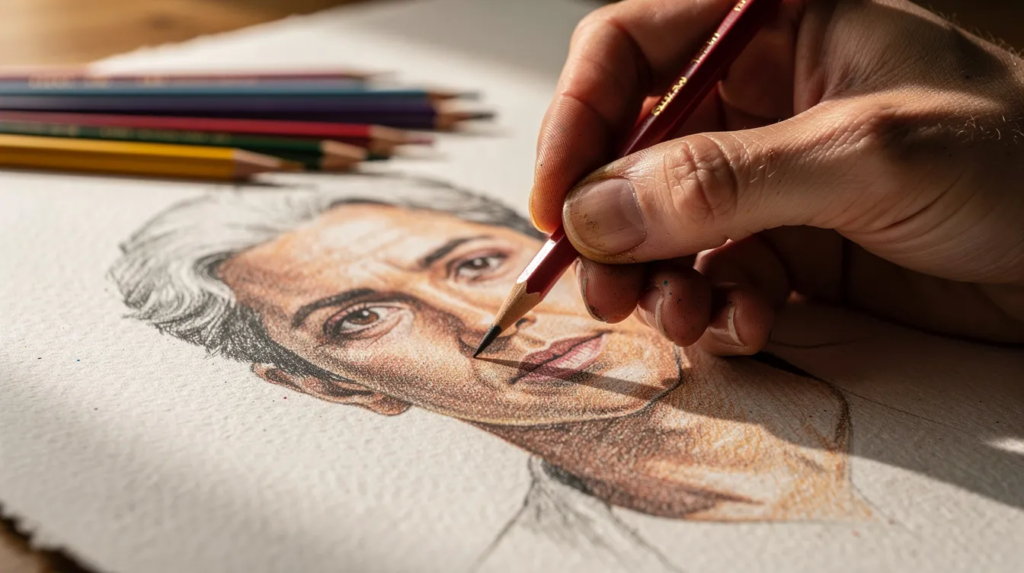
These subjects are chosen specifically for colored pencil practice, emphasizing the techniques that make this medium unique: layering, blending, burnishing, and texture work. If you want comprehensive instruction in colored pencil methods, explore the Colored Pencil Techniques guide or join Lisa’s courses in the It’s Easy To Draw Academy.
Layering is itself a form of blending. Many light, transparent layers build optical color richness that heavy pressure cannot achieve. Burnishing, using heavy pressure to flatten the paper tooth, creates a polished finish but limits further layering. Match your paper surface to your technique: smoother paper for burnishing and fine detail, textured paper for building depth.
- A metallic ornament. Chrome and silver surfaces teach you about reflection and require the full value range from white to black.
- An apple with visible skin texture. The subtle color variations across the surface showcase layering techniques.
- Iridescent insect wings. Color shifts require layered translucent applications. Build slowly rather than pressing hard.
- Human skin tones on a face. Flesh requires many subtle colors layered together. Avoid the temptation to use pink alone.
- A glass vase with water and stems. The transparency reveals colors behind and distorts the stems inside.
- Fur texture on a pet portrait. Work in the direction of hair growth. Vary pressure to create depth.
- A copper pot with patina. The oxidized surface combines warm metallics with green undertones.
- Water droplets on a leaf. The magnification effect inside the droplet challenges your observation skills.
- Satin fabric folds. The high sheen creates bright highlights against deep shadows. Sharp gradient control is essential.
- A slice of citrus fruit. The translucent segments allow light through, creating a glowing effect when rendered with proper layering.
Final Thoughts
Ideas alone do not make an artist. What transforms inspiration into skill is structured, consistent practice with guidance that helps you understand why techniques work, not just how to execute them. The 100 subjects above will give you direction whenever you ask yourself what to draw, but genuine growth comes from committing to the page regularly and building your craft over time.
If you are ready to move beyond ideas and into real skill development, consider joining the It’s Easy To Draw Academy. Lisa’s courses cover everything from foundational drawing skills to advanced colored pencil techniques, including the flagship course How to Use Colored Pencils Like a Pro. The academy community provides feedback, support, and connection with other artists who are serious about their creative development.
Pick one subject from this list. Set your timer. Start drawing.