This is the deep dive on the fundamentals referenced in our broader guide on how to get better at drawing.
You have probably heard artists talk about “the fundamentals” like they are some secret code the knew before they started learning. They are not. Drawing foundations are simply the handful of core skills that show up in every single drawing you will ever make. When these skills are solid, you can draw from life, from photos, and from imagination with genuine confidence. When they are weak, even your best efforts feel frustrating. The good news is that these foundations are learnable, and though they still take time, they are the fastest route to visible improvement if you are just starting to draw or returning after years away.
At It’s Easy To Draw, we built courses like “The Fundamentals of Drawing” specifically to cover these drawing fundamentals in a structured, beginner friendly way. You do not need to piece together random tutorials. You only need a clear path, and that is exactly what foundation drawing provides.

Why Drawing Foundations Matter
Drawing foundations are the essential skills that form the bedrock of your ability to draw whatever you imagine: from two-dimensional references, by translating three-dimensional objects into two-dimensional surfaces, and from imagination. Without these core abilities, you will keep bumping into the same walls: flat characters, muddy values, stiff poses, and that nagging feeling that “something is off” even when you cannot pinpoint what.
Here’s why building a solid foundation matters for every artist:
- Fundamentals are the leverage point. Instead of randomly practicing finished drawings, you work on the core skills that appear in every piece you will ever make. This is the faster path to progress.
- They unlock multiple modes of working. When you understand shape, value, and form, you can draw from observation, from reference photos, and eventually from imagination. The same toolkit applies everywhere.
- They reduce frustration. Knowing how to start a drawing and how to build it step by step removes the paralysis many beginners feel when staring at a blank page.
- They let you fix problems at the root. Flat shading is a value issue. Wonky proportions is a measurement issue. Understanding the fundamentals lets you diagnose what’s actually wrong and fix it.
The drawing foundation you build now will serve you for the rest of your artistic journey, no matter what style or subject you eventually pursue.
Getting Ready to Start Drawing (Drawing Materials, Tools, Mindset, and Space)
One of the biggest myths in art is that you need expensive drawing materials to start drawing. You do not. Simple, affordable tools are all you need to learn the basics, and in many cases, they are actually better because they let you focus on skill rather than gear.
Here is what to put in your starter kit:
- Pencils: Grab an HB pencil for lighter construction lines and a 2B for darker marks and shading. Reliable brands include Staedtler Mars Lumograph, Faber Castell 9000, or Derwent Graphic. A small set is better than a giant collection you do not know how to use.
- Paper: An A4 or 9×12 inch sketchbook with at least 120 gsm weight handles erasing and shading without tearing. Spiral bound books lay flat on a table, which is helpful. This is your laboratory, not a portfolio, so grab something affordable and fill it up.
- Eraser: A white vinyl eraser (like the Staedtler Mars Plastic) gives clean, precise corrections. A kneaded eraser is useful for gently lifting graphite when you want to lighten an area without scrubbing.
- Sharpener: A basic metal handheld sharpener is all you need. Keep your pencil tip reasonably sharp so you can make precise marks.
- Optional colored pencils: If you are interested in moving toward coloring and color theory later, a small set of student grade colored pencils like Faber Castell Classic or Prismacolor Scholar is a nice addition. However, focus on graphite first to understand value without the complexity of color.
- Setting up your space: You do not need a studio. A kitchen table or desk works perfectly. Place a single desk lamp at about 45 degrees to your subject and slightly above eye level. This creates clear light and shadow patterns on objects, which is exactly what you need when learning form and value.

Now for mindset. Expect wobbly lines at first. Expect awkward shapes. This is totally fine. Treat your drawing exercises as experiments rather than tests. Starting with light lines allows for easy correction during the drawing process, so press gently and refine as you go.
For now, graphite pencils are your primary tool, and they teach you everything you need to know about line and value. Other media (charcoal, ink, colored pencils, paint) all have their own characteristics, but the underlying skills you build with graphite transfer to every one of them.
Here is the schedule that works for busy adults: commit to 15 to 20 minutes per day. That’s it. James Clear’s concept of having a daily minimum practice is more effective than setting large, hard to meet goals, as it encourages consistent engagement with art.
Finally, you do not have to do this alone. It’s Easy To Draw runs a free Discord community where students can share their early sketches and get feedback. This kind of support makes the learning process less isolating and more motivating.jesus
Core Drawing Skills and Fundamentals You Must Learn First
This section covers the backbone of any drawing foundations course, including our “Fundamentals of Drawing” class at It’s Easy To Draw. In description, it is a comprehensive class, and its assignments reinforce the techniques and skills taught. These are the specific skills you need to learn before anything else will click. Think of them as the interlocking gears that make a drawing work. When one gear is rusty, the whole machine struggles.
The core fundamentals of drawing are line, shape, proportion, value, form, and basic perspective. Let us break each one down:
- Line and mark making: Line is not just an outline. Mark making involves training your hand to make precise lines and control pressure for varying tones. Consistency and intentionality in line control improve drawing skills. You will work with three main types: contour lines that describe the edges of an object (including inner edges like creases and overlaps), gesture lines that capture movement and flow, and construction lines that map out underlying structure before you commit to details. Drawing from the shoulder instead of the wrist allows for smoother, more confident lines, so practice longer strokes using your whole arm rather than just your fingers.
- Shape: Simplifying shapes involves breaking complex subjects down into basic geometric forms, such as spheres, cubes, cylinders, and cones. A human head can be simplified to an egg shape. A coffee mug is a cylinder with a rectangular handle. Basic shapes like circles, squares, and triangles are the building blocks of everything you will draw. Both positive space (the subject itself) and negative space matter. Negative space awareness helps ensure accurate composition by observing the shapes around and between the subject. Accurate drawing depends on training your eye to observe actual edges rather than symbolic shortcuts.
- Proportion and measurement: This is about the relationships between sizes in your drawing. Learning to draw is largely about learning to see accurately, with a focus on measuring distances and comparing sizes. You will use comparative measurement (using one part as a unit to estimate others) and sighting (holding a pencil at arm’s length to visually compare lengths and angles). Drawing from life strengthens observational skill more effectively than drawing from photographs. Accurate proportion is what keeps faces from looking “off” and figures from feeling awkward.
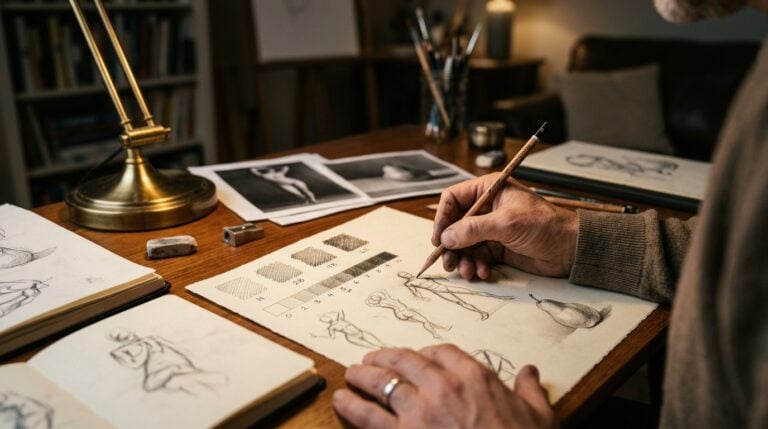
- Value: Value refers to the lightness or darkness of tones. Value and shading involve identifying the light source and separating light areas from dark to create volume. A simple 5 step grayscale value scale from white to dark is a foundational exercise that trains your eye to see and reproduce consistent increments. Without value control, drawings look flat. With it, they gain depth and dimension.
- Form: Form is shape plus depth. It is the difference between drawing a flat circle and drawing a sphere that looks like you could pick it up. You will practice drawing basic three dimensional forms in perspective: boxes, cylinders, spheres, and cones. These combine to build complex subjects. An arm is a series of cylinders. A tree trunk is a tapered cylinder. Once you can construct these forms in space, you can begin to invent objects from imagination.
- Basic perspective: Understanding perspective is essential for creating depth and realistic 3D space. In 1 point perspective, you look straight down a corridor or street where lines converge to a single vanishing point. In 2 point perspective, you view the corner of an object, with lines converging to two separate vanishing points. Think of drawing a row of buildings along a street (1 point) or a table in a kitchen seen from an angle (2 point). These systems give your drawings believable space and help you avoid the flattened look that plagues many beginners.
These six fundamentals work together as a system. Weakness in one area (say, proportion) will undermine even excellent shading or line quality. The key is to practice each skill deliberately while understanding how they connect.
For tactical exercises that train each fundamental in short daily sessions, see Best Drawing Exercises to Improve Your Skills. For the broader strategy of how fundamentals fit into a year of consistent improvement, see how to get better at drawing.