How To Get Better At Drawing (For Real This Year)
Stop plateauing. A practical guide to drawing exercises, study habits, and the foundations that turn frustration into real progress.
If you want to get better at drawing, here’s the truth that most people dance around: drawing is a trainable manual skill, not a magical talent reserved for the chosen few. You weren’t born bad at it, and you’re not missing some secret gene. You just haven’t practiced the right things in the right way yet.
Maybe you’re an adult who remembers enjoying art years ago but feels stuck at the same skill level since high school. Or perhaps you’re a returning hobbyist who picks up a pencil every few months, feels disappointed, and puts it back down. Either way, you’re not alone. At It’s Easy To Draw, we see this pattern constantly among beginner artists who feel overwhelmed by how much there seems to learn. The good news? You can improve your drawing skills with surprisingly simple daily actions. No weekend workshops required, no expensive equipment necessary.
This guide is your one-page roadmap. We’ll cover the core practices that actually move the needle: building pencil mileage, creating a sustainable drawing habit, mastering basic forms, learning to observe, practicing figure drawing, and planning your learning so you don’t stall out. These are the same principles we build our fundamentals courses around, and they work for hobbyists just as well as aspiring professionals. Let’s get started.
Draw A Lot (And Make It Doable)
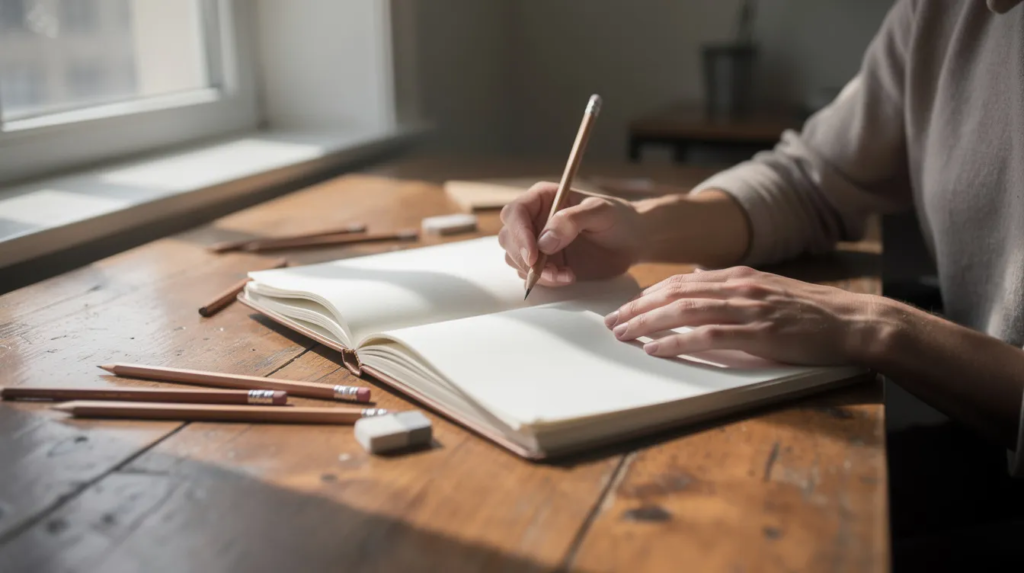
The single biggest predictor of improvement is pencil mileage. Consistent practice is essential, because each session strengthens the neural pathways that coordinate hand and eye. You need to draw a lot, not once a month when inspiration strikes.
Neuroimaging studies show that drawing activates the posterior parietal cortex, which coordinates hand-eye coordination and spatial mapping. Daily sketching for 10 to 15 minutes builds comfort and confidence far more than occasional marathon sessions.
Commit to 20 minutes of drawing a day for the next 30 days. That’s it. No hard and fast rule about what you draw. Just draw. Twenty minutes might be a page of warm-up shapes, five quick sketches of objects on your desk, ten gesture drawings from a reference photo, or a single still life of your coffee mug.
Students who complete 30-day drawing challenges consistently report visible improvements in line confidence and form awareness after just a few weeks. By week four, when you compare new sketches with your first pages, the difference is obvious. The process isn’t magical. It’s mechanical. Your hand learns the motions, your eye gets sharper, and your brain builds the pathways.
Draw a lot, even if it’s just a little each day. For specific exercises that fit a 10-20 minute session and target different skills, see Best Drawing Exercises to Improve Your Skills.
Build A Sustainable Drawing Habit
Skills fade without use. The goal isn’t a heroic weekend binge where you draw for six hours and then don’t touch your sketchbook for two weeks. The goal is a consistent drawing habit that becomes automatic, like brushing your teeth.
Habit research shows that forming a new behavior into a genuine habit takes an average of 66 days, though the range spans from 18 to over 250. Drawing, as a complex visuomotor skill, tends toward the longer end. A few principles make it stick:
Attach drawing to an existing routine. If you already drink coffee every morning, draw during that time. If you watch TV in the evening, sketch during the first episode. This is called habit stacking, and it works because you’re piggybacking on a cue your brain already responds to.
Start tiny. Five minutes of doodling each evening is enough to begin. Once that feels natural, usually after two to three weeks, extend to ten, then fifteen. The friction of starting is the real enemy, and tiny starts eliminate it.
Keep a sketchbook. A sketchbook is a low-pressure space with no audience and no judgment. Over time, you’ll notice personal styles or recurring themes emerging without forcing them.
Track your streaks. Use a simple monthly calendar and mark each day you draw. Aim for “don’t miss two days in a row” rather than perfection. At It’s Easy To Draw, we see the most progress in students who log practice days in our community.
If sticking with practice is your real obstacle, the bigger lever is making drawing genuinely enjoyable instead of treating it as homework. For a deeper look at mindset and how to keep your practice fun through the boring stretches, see Drawing Is Fun: How To Enjoy Drawing More Every Day.
Master Pencil Control And Basic Forms
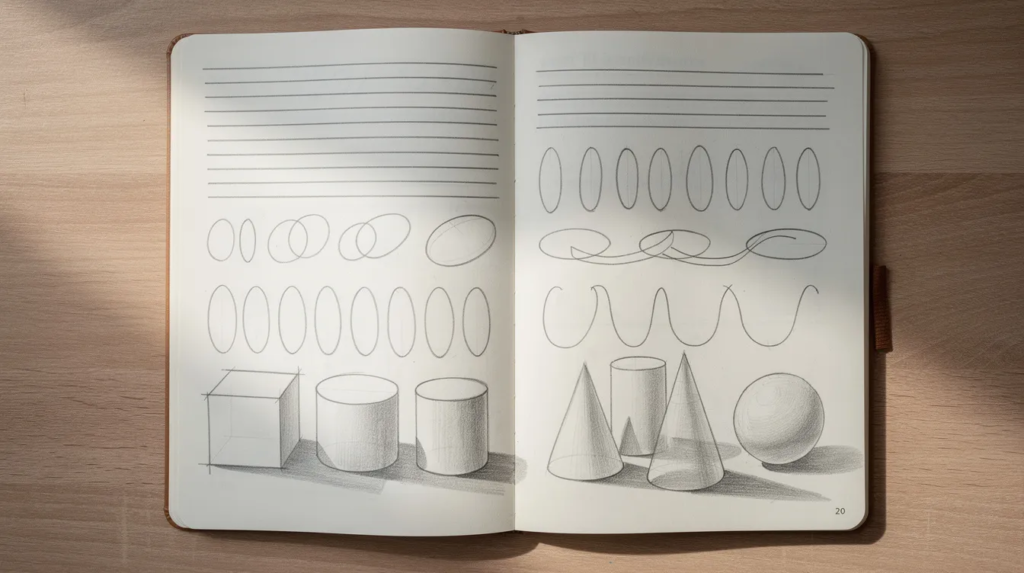
Pencil control is the fastest way to feel better at drawing within a week or two, because it affects every single line you put down. Before you worry about anatomy, perspective, or rendering textures, you need smooth, confident mark making.
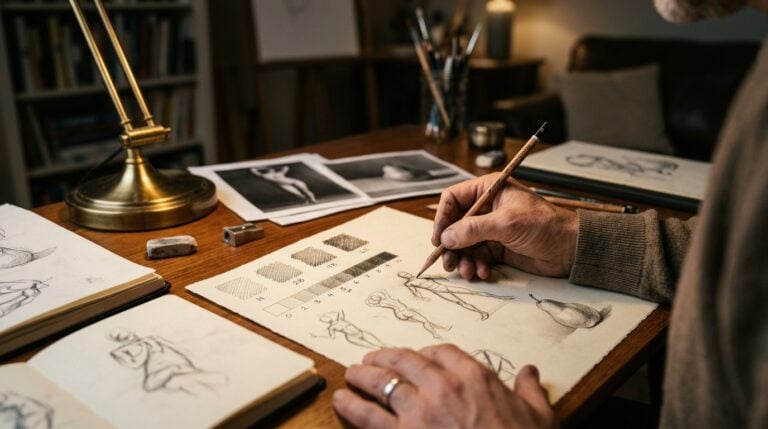
Two layers matter here. The first is pure pencil mileage: drawing lines, ellipses, and curves until your hand stops shaking and your marks become deliberate. The second is understanding the underlying forms (spheres, cubes, cylinders, cones) that every complex object breaks down into. A face, a car, a dragon, your coffee mug. All combinations of simple 3D shapes.
Spending a few weeks deliberately practicing these basics shortcuts the frustration that comes later when you try to tackle complex subjects without the foundation in place. Our Fundamentals of Drawing course spends its early modules on exactly this.
For the full warm-up routine and seven more targeted exercises that build line confidence, accuracy, and spatial awareness, see Best Drawing Exercises to Improve Your Skills. For a deeper dive on lines, shapes, value, form, proportion, and perspective as an interconnected system, see Foundation in Drawing: A Practical Guide for Adult Beginners.
Learn To See: Observation, References, And Organic Shapes
Improving your drawing skills is mostly about learning to see accurately rather than learning tricks or formulas. The good drawing you admire from other artists comes from their ability to observe, not from memorized templates.
Your brain carries a “symbol library” of generic ideas: a generic eye, a generic tree, a generic mug. When you draw what you think a mug looks like, you draw the symbol. When you draw what you actually see (the specific oval of the rim, the angle of the handle, the negative space underneath), you draw the real object. The first looks flat. The second looks alive.
Use references generously, but use them actively. Draw from real objects on your desk, from quick phone photos, and from life whenever possible. A photograph flattens depth and pre-selects angles for you. Real objects teach you to make those decisions yourself.
Practice on organic shapes specifically: plants, drapery, clouds, crumpled fabric. These flowing irregular forms train you to handle contours that aren’t perfectly geometric and prevent your work from looking stiff or mechanical.
Observation is the first of seven principles we cover in The Essential Rules of Drawing for Beginners, and it ties directly into the foundational skills covered in Foundation in Drawing.
Practice Figure Drawing Without Intimidation
Figure drawing is a powerful way to improve proportion, gesture, and confidence, even if you have zero interest in becoming a character designer. Humans are what we see most often, so we’re extremely sensitive to when figure proportions look “off.” Training your eye on figures trains it for everything else.
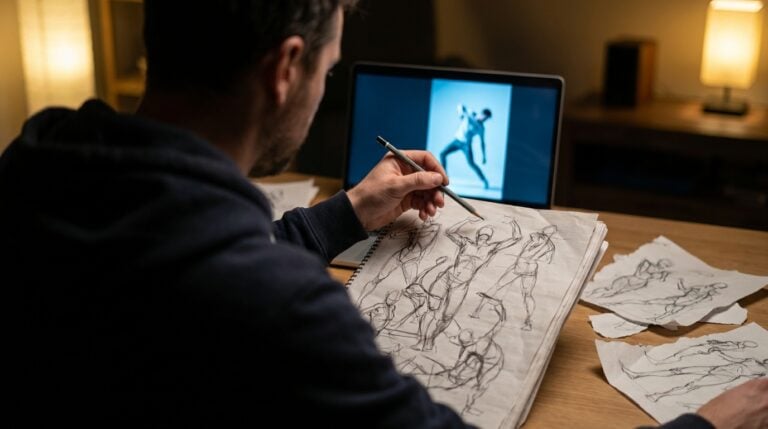
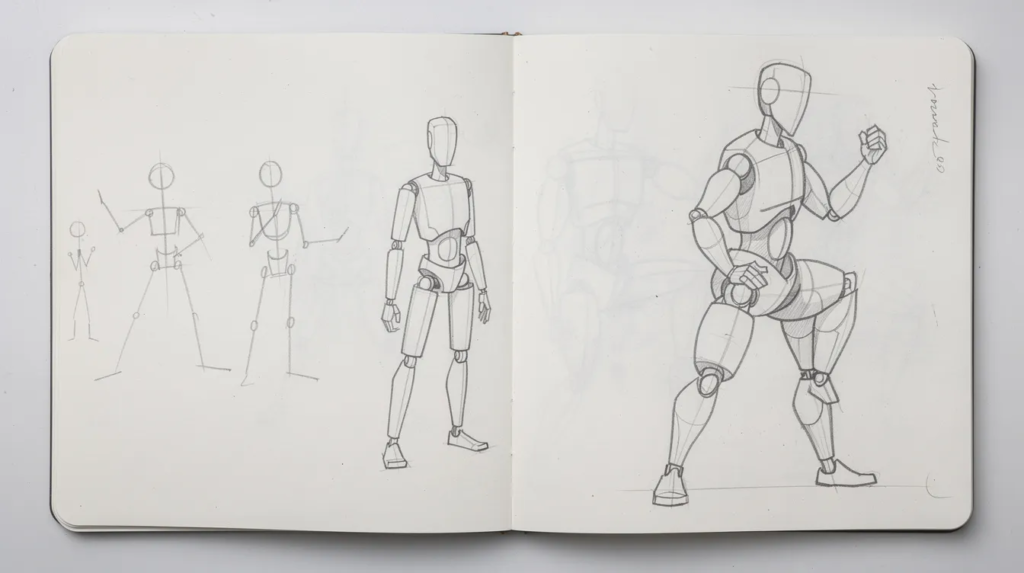
There are two flavors of figure practice you need. Quick gesture drawings (30 seconds to 2 minutes) capture the line of action: the invisible curve that runs through a pose showing its rhythm and balance. Longer poses (10 to 20 minutes) let you go deeper on proportions, anatomy landmarks, and light. Both belong in your practice rotation.
The mindset shift that matters most: spend roughly 70% of your figure time on structure (big angles, gesture, balance, basic proportions) and only 30% on detail and rendering. Beginner artists rush to eyes and fingers while the whole torso is tilted wrong. Resist that urge. Simplified stick figures and mannequin forms are expected and encouraged at first.
For a step-by-step gesture drawing routine and how to combine it with the other foundational exercises, see Best Drawing Exercises (exercise 3 covers gesture in depth).
Plan Your Learning So You Don’t Stall
Random tutorials from the internet can feel productive, but they often lead to plateau. You watch an impressive speed-paint, try to copy it, fail, and move on to the next video. Months pass. Your skill level barely changes. That’s not a learning process. That’s entertainment.
Improvement comes faster with a loose plan for what to study each month. Here’s a concrete example of a 3-month roadmap:
Month 1: Lines and forms. Focus on pencil control warm-ups, drawing basic shapes in 3D, understanding light direction on simple forms. Use one page of warm-ups daily plus sketches of household objects.
Month 2: Basic perspective and boxes. Learn one-point and two-point perspective. Draw boxes, rooms, simple buildings. Art books on anatomy and perspective serve as foundational resources. Invest in one or two and actually work through the exercises.
Month 3: Figure drawing and simple anatomy landmarks. Practice gesture drawings, learn basic proportions (head heights, shoulder width), and study how the ribcage and pelvis connect. Look at how your favorite artists structure their figures.
Choose 1 to 2 topics per month instead of jumping around. Stick with them long enough to see actual change before moving on. Developing your drawing style is a gradual process that requires patience and consistent practice over months and years.
Every four weeks, pull out your earlier drawings and compare them with new work. Adjust your next month’s focus based on what still needs attention. This prevents the false sense of progress that comes from always doing what’s comfortable.
At It’s Easy To Draw, our courses and community challenges provide ready-made learning paths so you don’t have to design everything from scratch. But even if you’re fully self-directed, having a written plan beats random wandering every time.
Stay Motivated: Draw What You Love And Use Community Support
Mix your “serious” studies with fun drawings of subjects you genuinely love. Pets, fantasy characters, fan art, plants, mandalas, portraits of your favorite musicians. All of it counts. The point is continuous work that keeps your habit alive through the months when progress feels slow.
Skills transfer across subjects. Practicing dragons still improves line work. Drawing flowers still teaches observation. Rendering metallic armor still builds your understanding of light and form. The studies and the fun drawings reinforce each other.
Community accelerates everything. Feedback from peers and mentors catches blind spots you’d never notice alone. Our Discord, Reddit community, and course platform exist specifically to help members stay accountable and get constructive critique. There’s no hard and fast rule about where to find community. Just find one and participate.
For the full mindset toolkit (small wins, quieting the inner critic, playful exercises, and finding your tribe), see Drawing Is Fun: How To Enjoy Drawing More Every Day.
Next Steps: From This One Page To Your First Year Of Growth
The core loop is simple: draw a lot, build a habit, practice pencil control and basic forms, observe carefully, study figures, and follow a plan. That’s the entire idea. No secret techniques. No magic drawing tool. Just consistent practice with focus.
Your starting today checklist in one sentence: do 10 minutes of warm-ups (straight lines, curves, ellipses), plus one page of simple object sketches from observation, and date your page so you can track progress.
If you want structured support, explore our Fundamentals of Drawing course for a complete foundation, or dive into How to Use Colored Pencils Like a Pro if you’re ready to add color to your practice. Our community challenges give you prompts, accountability, and feedback from fellow artists at every skill level.
Sign up for our free newsletter to get regular drawing prompts, blog post updates, and mini exercises delivered to your inbox. It’s a low-pressure way to keep art in your life even during busy weeks. Subscribe to our YouTube channel where Lisa posts new videos every week on how to get better at drawing and coloring, complete with free downloadable pages you can use to follow along.
Six to twelve months of this approach can completely transform how you feel about your artwork. The person who fills sketchbooks with confident sketches, who can look at any object and break it into forms, who understands why a pose works. That’s a person just a year of consistent practice away. You don’t need more talent. You need more pages. Start today.