You spent hours layering, blending, and building color. Now you want that piece to look just as vivid ten or twenty years from now. Here is everything I know about keeping colored pencil drawings safe for the long haul.
What Is the Safest Way to Preserve Colored Pencil Drawings?
The best way to preserve colored pencil drawings is to use acid free paper from the start, keep the surface untouched while you work, store finished drawings flat with glassine, and frame behind glass with UV protection. A light fixative made for dry media is optional, not the foundation of preservation.
For most colored pencil art on paper, smart storage and proper framing do far more than any spray ever will. Good materials, careful handling, and the right environment are the non-negotiable pillars. Fixative sprays can help with specific problems like wax bloom or smudging, but they are not a magic shield, and heavy application can actually darken or flatten your work.
These tips apply to finished drawings and works in progress alike. Light exposure, dust, moisture, temperature fluctuations, smudging, and physical damage all threaten colored pencil artwork, so you need a plan for every stage. Some advice floating around online, especially the hairspray trick, can introduce acid, yellowing agents, and stickiness that ruin your precious artwork over time.
My own process is simple. I protect the surface while working, use fixative sparingly and only for a specific problem like heavy wax buildup, and rely on archival storage and framing to guard against everything else. The rest of this post covers supplies, handling, storage, framing, when to spray and when not to, and how all of this differs from graphite drawings and paintings.
Which Archival Paper and Pencils Have the Best Lightfastness?
The life of colored pencil art is decided before the first stroke, by paper and pencil choice. If the foundation is cheap, no amount of fixative or framing will save a drawing from yellowing paper and fading color.
Paper matters first. Use acid free paper that is lignin free and ideally 100% cotton or high alpha-cellulose. Archival options like Fabriano Artistico, Legion Stonehenge, and Strathmore 500 series resist brittleness and yellowing far longer than a standard wood-pulp drawing pad. Lignin in cheap school pads produces acid as the paper ages, and that acid eats the fibers from the inside. Acid free materials prevent acid migration that can damage artwork over time, and this applies equally to graphite and other dry media.
Pencils matter next. Some colored pencils may have different lightfastness ratings than others, even within the same set. Using lightfast-rated colored pencils like Faber-Castell Polychromos or Caran d’Ache Luminance minimizes fading risks. Research at Queen’s University found that artist-grade sets show a color shift (ΔE*) of about 2.9 under accelerated aging, while many student pencils shift by 9 to 10. That is the difference between a drawing that still glows and one that looks washed out.
Wax-based pencils like Prismacolor Premier tend to develop wax bloom, a hazy white film caused by wax migrating to the surface. Oil-based pencils bloom less but can be stiffer and sometimes carry less pigment. Know which type you are using because it affects how you seal and clean the finished piece.
Paper is far more vulnerable to environmental change than canvas. Archival materials enhance the longevity of colored pencil artwork, so invest in supports before you invest in sprays. I have my students make a small swatch card of their favorite colors, cover half, and leave it in a sunny window for a few weeks. When they pull it out and see which pencils faded, especially those bright pinks and neons, they never skip lightfastness ratings again.
How Do You Protect the Drawing Surface While You Work?
Micro-scratches, hand oils, and casual smudging slowly destroy the subtle detail in colored pencil work. Colored pencil surfaces are vulnerable to smudging and surface damage, and colored pencil drawings require specific handling techniques to avoid damage. Prevention here is effortless once you build the habit.
-
Keep a clean sheet of plain paper or glassine under your drawing hand to block skin oils and smears on colored pencil and graphite layers alike.
-
Keep nails and jewelry away from the paper surface. Never stack other art supplies directly on top of an in-progress drawing.
-
Work on a rigid support board so the paper stays flat and does not develop pressure dents. Think of it like mounting a canvas for acrylic paintings: a taut, stable surface lets you control every mark.
-
Avoid burnishing too early. Crushing the paper tooth with heavy pressure locks you out of adding a new layer and makes any workable fixative less effective because the surface is too smooth to grip.
The most common mistake I see is students resting a bare hand on finished areas. I teach them to work from the top corner away from their drawing hand, keep a glassine guard in place, and brush off pencil crumbs with a soft brush. Never a hand or a fingertip.
How Do You Store and Transport Colored Pencil Drawings Safely Short-Term?
The two biggest risks in transit are friction, which causes smudging and flattening, and humidity, which causes cockling and sticking. A few simple habits keep your colored pencil work safe between sessions and during travel.
Store drawings flat, never rolled. Rolling can crack pigment layers and crease paper fibers. If you absolutely must transport a very large piece, roll it gently into an appropriate tube as a last resort, but flat storage is always safer. Use glassine paper to interleave between drawings to prevent smudging. Regular copy paper can catch loose pigment, stick to wax layers, or leave a shiny transfer patch. Interleaving with smooth, acid free materials reduces scratching and pigment transfer.
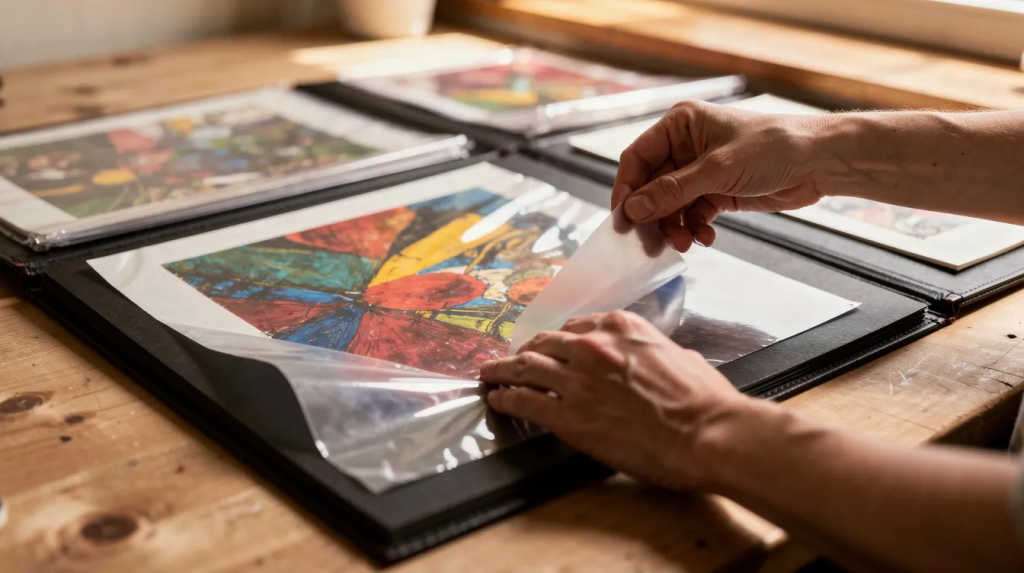
Place each drawing in an archival clear sleeve with glassine on the face, then slide it into a rigid portfolio or clamp it between two smooth boards. For sketchbooks and small pads, seal them in large ziplock bags to block humidity, and use binders with plastic sheets for storing sketches that you revisit often.
My students sometimes cover a fresh drawing with a scrap of magazine page or plain copy paper and later find waxy transfer or a glossy patch. I have them keep a stack of glassine sheets right in their portfolio so the same process becomes automatic.
How Do You Store Colored Pencil Drawings Long-Term? Humidity, Light, and Archival Containers
Over years, humidity and light are bigger enemies than an accidental fingerprint. Monitor the temperature and humidity to protect artwork from deterioration effects, especially for unframed colored pencil drawings sitting in storage.
-
Maintain a stable temperature around 65 to 75°F and humidity around 40 to 50%. Relative humidity above 65% invites mold, while very low humidity can make paper brittle.
-
Store artwork flat in archival-quality protective folders or boxes. Use solid storage boxes that can bear heavy loads. Store drawings in plastic lockable containers to prevent humidity from creeping in, and separate each piece with glassine.
-
Store colored pencil artworks in cool, dry places to prevent deterioration. Avoid direct sunlight and bright artificial lighting.
-
Include silica gel or other desiccant packs inside closed containers and replace them every few months or at least once a year.
-
Label and date every box so older colored pencil art and more posts or series you have created can actually be found and enjoyed.
-
Framed works should be stored in a vertical position, above floor level, with bubble wrap around the frame only, and never stacked glass to glass without padding.
The closet under the stairs and the garage shelf are where I see the most ruined work. I tell students to store art where they would be comfortable sitting themselves. If that space is hot, damp, or dusty, your drawings will suffer there too.
How Do You Frame Colored Pencil Art With Glass, Mats, and UV Protection?
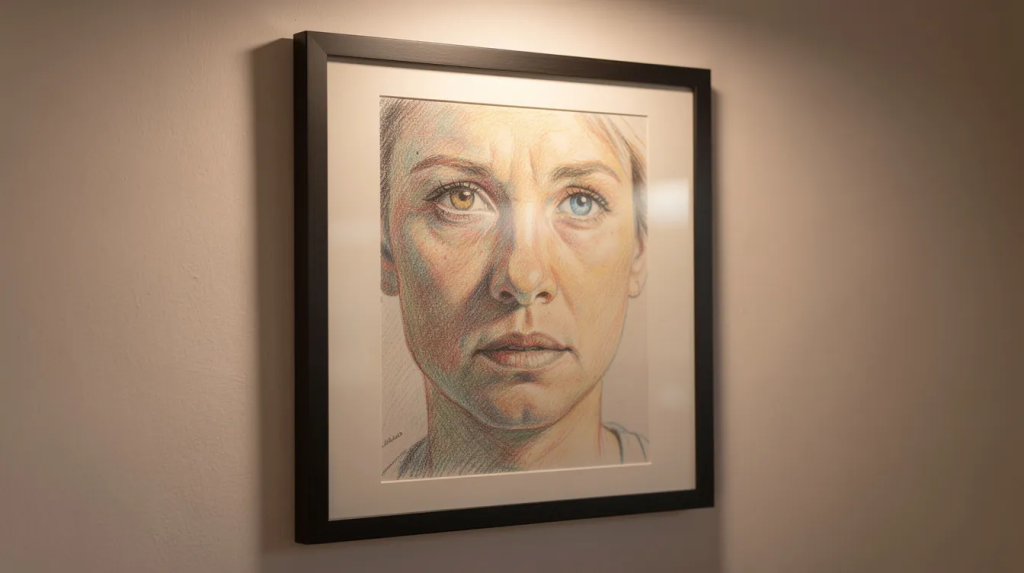
Framing behind glass is the safest long-term choice for colored pencil drawings on paper, far more protective than any heavy fixative spray alone. Unlike varnished oil painting surfaces, colored pencil and graphite are never sealed into a continuous film, so they need that physical barrier of glass to protect against dust, moisture, and abrasion.
Here is what proper framing looks like:
-
Mat or spacer. Framing with spacers keeps artwork from direct contact with glass, preventing moisture transfer, condensation sticking, and pigment transfer. The mat is part of the preservation, not decoration.
-
Acid free materials. Use archival mat board and backing board. Seal the frame backing with archival tape to keep out dust and insects.
-
Glazing options. Frame artwork with anti-glare glass to reduce fading, or choose UV-filtering glass or acrylic when framing colored pencil artwork. UV light causes pigments to fade and paper to discolor, and UV-filtering glazing blocks most ultraviolet wavelengths below 400 nm.
-
Placement. Hang colored pencil drawings on interior walls, away from direct sunlight and not directly opposite a window, and never above heat sources or in very humid rooms.
-
Professional framing is recommended for valuable colored pencil artwork, especially those pieces you plan to display or sell.
Students often frame a piece tight to the glass to save money on the mat, then find wax bloom or moisture stuck to the glass weeks later. Always create that air space.
Do You Need Fixative Spray for Colored Pencils? When, What, and How
Fixative sprays are tools, not magic shields. Fixatives are designed for dry media like colored pencils, and they can help with specific problems, but fixatives can change the appearance or texture of colored pencil work if you overdo it.
Workable fixative vs. final fixative. A workable fixative is designed so you can keep drawing over it. Workable fixatives restore tooth for layering in drawings, making them useful between heavy passes. A final fixative is applied once your piece is complete. Final fixatives protect art from dirt and UV damage. Never use a final varnish, gloss spray, or any varnish made for oil paintings or acrylic paintings on paper. Varnishes can discolor paper and darken colors, and they are not suitable for colored pencil artwork.
When I use fixative:
-
To control wax bloom on heavily layered, waxy areas
-
To lightly restore tooth so I can add a new layer of color
-
To help blend a mixed media piece combining graphite and colored pencil
How to apply correctly:
-
Work in a well ventilated area or outdoors
-
Set the artwork in a vertical position on a board
-
Hold the spray can about 12 inches from the artwork
-
Apply multiple light coats instead of one heavy coat
-
Let fixative dry for at least 30 minutes before handling
-
Always test fixative on scrap paper before applying to artwork, using the same pencils and paper as your finished piece
Some sprays slightly deepen values or shift saturation. That might be useful on a matte piece you want to feel richer, or disastrous on a super thin, delicate illustration. Decide case by case. Use a workable fixative during the drawing process only when you have a reason, and avoid spraying everything “just to be safe.”
My method is to skip fixative on most pieces. I use one very light pass only on heavily layered areas that tend to bloom, and I test on a scrap card first. Students who spray a thick coat to feel careful usually end up with a dull, flattened surface that lost the texture and luminosity they spent hours building.
If you want a small project for practicing layers that hold up well, try learning how to color gemstones with colored pencils.
What Should You Never Use on Colored Pencil Drawings? Hairspray, Varnish, and Common Myths
Avoid using hairspray as a fixative for artwork. Hairspray formulas change constantly, contain perfumes and plasticizers, and are not tested for archival stability. Over time it can yellow, crack, and turn sticky, trapping dust on the surface of your drawings. If you would not trust a product around a family photo you care about, do not put it on a drawing you care about.
Traditional picture varnishes designed for oil or acrylic paintings, especially damar varnish, should never be brushed or sprayed onto paper. Varnish protects against UV light and dirt on a paint film, but on paper it soaks in, stains, and makes the sheet brittle. Varnishes are not suitable for colored pencil artwork.
Avoid cheap craft sprays that do not say “for dry media” or “archival.” Read labels for terms like acid free, non yellowing, non toxic, and UV protective. Even the correct fixative, over-applied, will flatten the texture and crush the layering that makes colored pencil art luminous. Restraint is itself a preservation strategy.
How Does Preserving Colored Pencil Differ From Graphite Drawings and Paintings?
If you work in other media like graphite, pastels, acrylic, or oil, some rules overlap and some do not.
-
Colored pencil vs. graphite. Both are dry media on paper. Both prefer flat storage, glassine interleaving, and framing behind glass. Graphite smudges more easily, while wax-based colored pencil is more prone to wax bloom and indentation.
-
Paintings. Acrylic paintings and oil paintings form continuous paint films usually protected with removable varnishes that can be cleaned or replaced by conservators. Fixative on paper is more permanent and less reversible. You can sometimes gently clean a canvas surface, but the surface of a colored pencil or graphite drawing is off limits. Cleaning is limited to the frame and glass.
-
Mixed media practice. If you create in multiple media, keep separate storage strategies for your dry media pieces and your canvases instead of treating all artworks identically.
How Do You Care for Colored Pencil Drawings Over Time? Documentation and an Archival Mindset
Think of yourself as a creator of things that may outlive you. That shift in perspective changes every decision, from the paper you grab off the shelf to where you hang a finished piece.
-
Periodically check stored drawings for mold, waviness, or insect damage, especially those in humid climates, and address issues early.
-
Scan or photograph finished colored pencil drawings at high resolution before framing or shipping. This creates a backup and a portfolio asset. Documenting sketches and materials can help track artwork’s condition and history.
-
Label the back of every piece with the date, the brand of pencils and paper type used, whether you applied fixative and how many coats, and any basic care notes for future owners or galleries.
Colored pencil artworks can last for decades when properly protected and stored. At It’s Easy To Draw I teach not only how to create colored pencil drawings but also how to care for them so students feel confident their work will still glow years from now. Caring for your art is part of being an artist, and it starts the moment you pick up a pencil. When you are ready to go deeper, my course on using colored pencils like a pro is the next step.
FAQ
Do you need to spray colored pencil drawings with fixative?
Usually no. A light, dry-media-safe fixative is optional and mainly helps with wax bloom or smudging. Archival paper, glassine, and framing under glass do most of the preserving.
Can you use hairspray on colored pencil drawings?
No. Hairspray can yellow, turn sticky, and is not archival. Use a fixative made specifically for dry media if you need a spray at all.
How do you prevent wax bloom on colored pencil drawings?
Build layers at medium pressure, avoid heavy burnishing too early, store drawings at stable temperatures, and frame behind glass. If bloom appears, gently buff it off with a soft cloth and, if needed, apply one very light coat of workable fixative after testing on scrap paper first.
How should you store colored pencil drawings?
Store artwork flat in archival-quality protective folders or boxes, never rolled, with glassine between pieces. Keep boxes in a cool, dry space away from heat, damp, and light, ideally at around 40 to 50% humidity. Store drawings flat with glassine paper covering them.
Do colored pencil drawings fade over time?
Some do. Pencils with poor lightfastness ratings fade faster, especially pinks and neons. Choose artist-grade rated pencils and use UV-filtering glass and sensible placement to slow fading significantly.
Should colored pencil drawings be framed under glass?
Yes. Use a mat or spacer so the glass does not touch the drawing, with acid free mat board and backing, and UV-filtering glass or acrylic for the best protection.